12 Online Business Ideas — Each With a Real Business Behind It
The online business ideas worth your time are the ones somebody already earns from. Below are 12 types of online business, and each one is tied to a real, bootstrapped company: who built it, what it sells, and the revenue it reports. Every example is a boring business — a dull product, steady demand, a small team.
We've profiled over 100 of these businesses on BoringCashCow. The selection rule for this list is simple: people already search for the thing, and the business needs little upkeep once it runs. No trend picks, and no idea without an example behind it. If you'd rather start from the method than from a list, read how to find a boring business idea first.
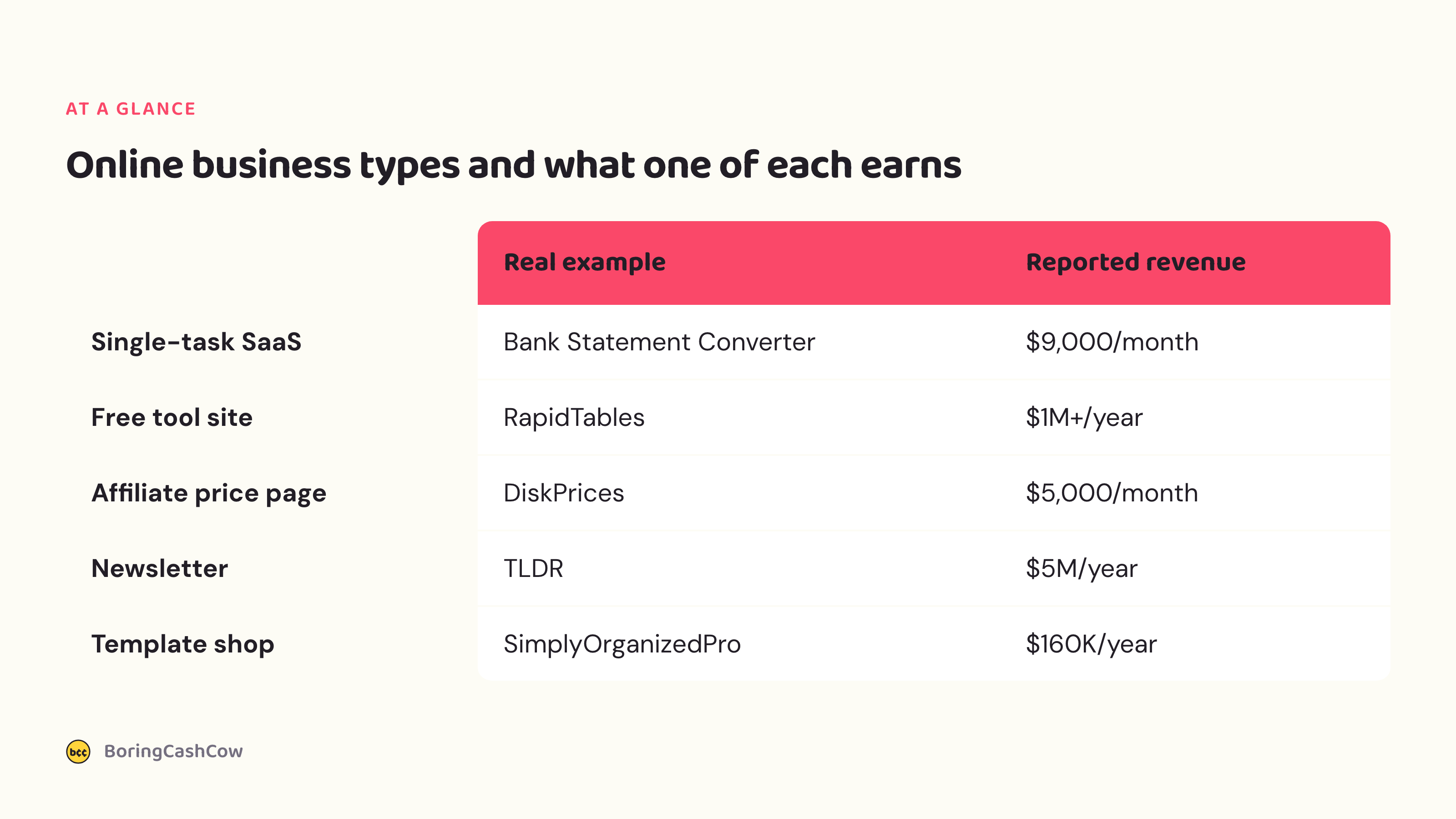
The 12 ideas at a glance
| Business type | Real example | Reported revenue | How it earns |
|---|---|---|---|
| 1. Single-task SaaS | Bank Statement Converter | $9,000/month | Subscriptions |
| 2. Back-office automation SaaS | Parseur | $40,000/month | Subscriptions |
| 3. Mobile app | Hevy | $40,000/month | Freemium |
| 4. Browser extension | GoFullPage | $120K/year | Freemium |
| 5. AI generator | Emojis.sh | $105K/month | Subscriptions |
| 6. Niche search tool | Seats.aero | $1.5M/year | Recurring revenue |
| 7. Free tool site | RapidTables | $1M+/year | Display ads |
| 8. Niche reference site | TractorData | $46,000/month | Display ads |
| 9. Affiliate price page | DiskPrices | $5,000/month | Affiliate commissions |
| 10. Newsletter | TLDR | $5M/year | Sponsorships |
| 11. Niche job board | OnlineJobs.ph | $10M+/year | Subscriptions |
| 12. Template shop | SimplyOrganizedPro | $160K/year | One-time sales |
The figures come from our case studies, linked under each entry. They are what these founders report, not what a new business should expect in its first year.
Why start online
Because the costs are small enough that a slow start doesn't kill you. Most of the businesses below were started by one or two people, without funding, on plain technology: PHP and MySQL, Python and SQLite, jQuery. The most common stack among our case studies costs under $10/month to host.
That changes the math. A shop with rent needs customers in month one. A web page that costs less than lunch can sit for a year while search traffic finds it. TractorData launched in 2000 and still earns from the same idea.
The trade-off is time. Several of these started as side projects: DiskPrices, GoFullPage and TractorData among them.
Software ideas
Software that does one unglamorous job and charges for it. You need to be able to build it, or pay someone who can.
1. Single-task SaaS: Bank Statement Converter — $9,000/month
Angus Cheng built a tool that converts bank statements from hundreds of banks into clean Excel files. He launched it in 2021 as a subscription and grew it entirely through SEO and blog content. One input, one output, and a customer who has the problem every month. Full case study →
2. Back-office automation SaaS: Parseur — $40,000/month
Sylvestre Dupont and Sylvain Josserand started Parseur in 2016. It pulls data out of emails and PDFs automatically, which is work companies used to hand to a person. Organic search is the primary growth channel, and the site ranks #1 for competitive keywords. Full case study →
3. Mobile app: Hevy — $40,000/month
Guillem Ros and Desmond McNamee built a workout tracker. It is free to use, with a paid tier at $3.99/month, and has passed 2 million users. The website gets 725K monthly visits, and 77% of that traffic comes from organic search. An app still needs a website that ranks. Full case study →
4. Browser extension: GoFullPage — $120K/year
Peter Coles wrote a Chrome extension in 2012 that captures a full-page screenshot. The basic version is free and the premium features cost $12/year. That is the whole business: one extension, one small annual price. Full case study →
5. AI generator: Emojis.sh — $105K/month
Alexandru Ţurcanu, a solo founder, built a site that generates custom emojis with AI and sells subscriptions to it. It gets 703K monthly visits and made $105K in a single month. The model does the work; the business is the narrow use people will pay for. Full case study →
6. Niche search tool: Seats.aero — $1.5M/year
Ian Carroll built a search tool for award flights in mid-2022, so travelers can see where their airline miles will get them a seat. No employees, no funding, and $1.5M in annual recurring revenue within two years. 88.6% of the traffic is direct: people come back because it works. Full case study →
Content and media ideas
Sites and emails that attract an audience first and earn from ads, affiliates, sponsors or listings. They need less code and more patience.
7. Free tool site: RapidTables — $1M+/year
A collection of free calculators: GPA, mortgage, BMI, unit conversions. It was created in 2007 by an anonymous founder, runs on jQuery and Bootstrap, and now gets 26.7 million monthly visits. All of the revenue is Google AdSense. Full case study →
8. Niche reference site: TractorData — $46,000/month
Peter Easterlund launched a website of tractor specifications in 2000. It gets 1.2 million monthly visits and earns $46K/month from display ads. PHP, MySQL, one person. The lesson is the subject: pick a field where people look things up and nobody has organized the facts. Full case study →
9. Affiliate price page: DiskPrices — $5,000/month
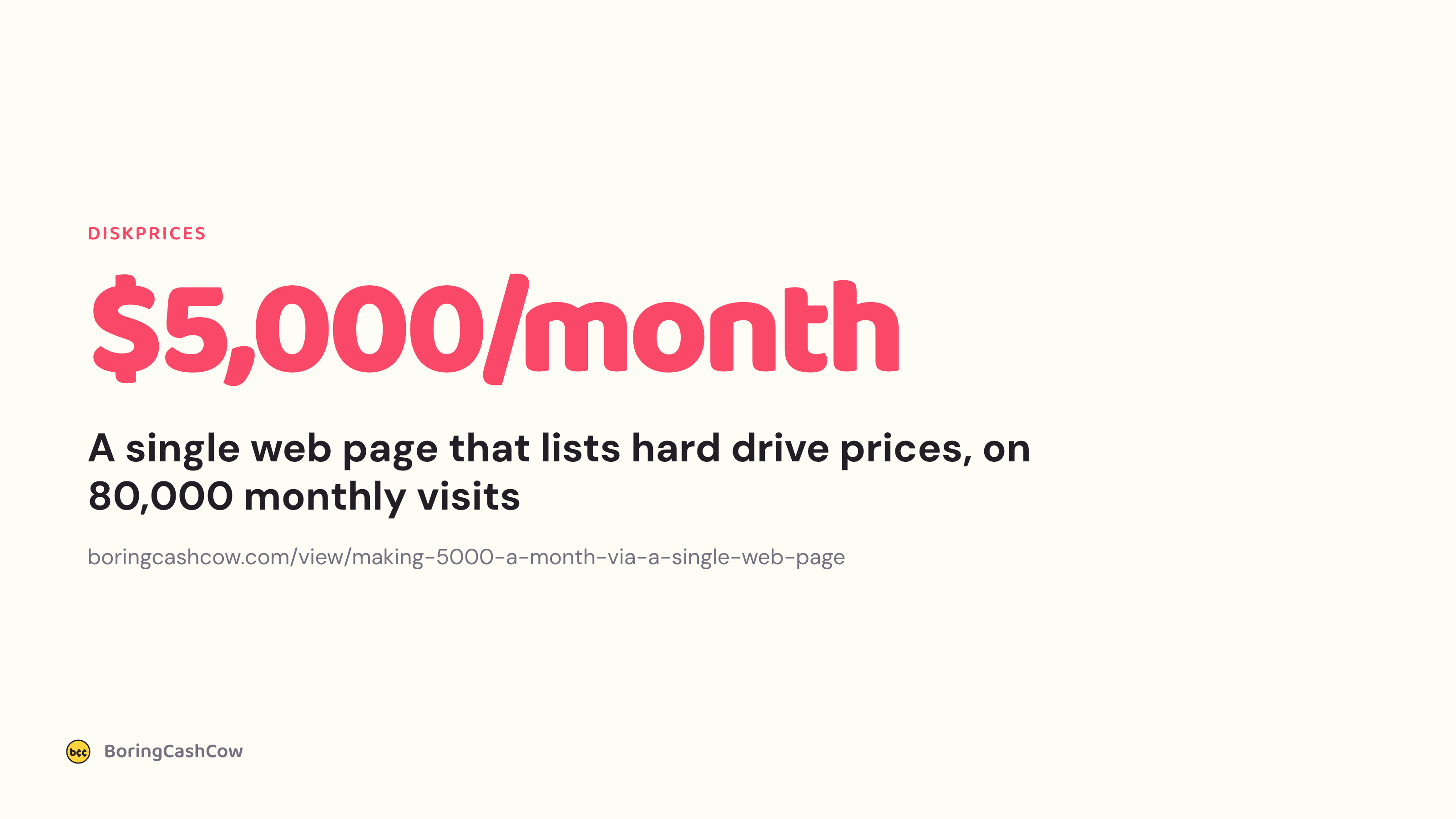
Jeremy Grosser built a single web page that lists hard drive prices. It earns $5K/month in Amazon affiliate commissions on 80,000 monthly visits. One page, Python and SQLite. This is the smallest business on the list, and the easiest to picture building yourself. Full case study →
10. Newsletter: TLDR — $5M/year
Dan Ni started a daily tech news email in 2018. TLDR now reaches 1.2 million subscribers and charges up to $18,000 for a sponsorship placement. $5 million a year from summarizing news. Full case study →
11. Niche job board: OnlineJobs.ph — $10M+/year
John Jonas built a job board in 2008 that connects businesses with Filipino virtual assistants. Employers pay a subscription, and the site takes no commission on what workers earn. Revenue passed $10 million in 2022. Full case study →
Digital product and e-commerce ideas
Selling a file instead of a subscription. There is nothing to ship and nothing to restock.
12. Template shop: SimplyOrganizedPro — $160K/year
A seller known as HJ started listing spreadsheet templates on Etsy in December 2022. Each template sells for $1–$2.50. The shop has made over 39,000 sales across 24 products. The marketplace brings the buyers, so there is no website to rank. Full case study →
What about services and physical products?
Freelancing, consulting, virtual assistance, dropshipping and print-on-demand appear on most lists of online business ideas. They are not on this one, for a plain reason: we don't have a case study of one with reported revenue, and we don't list an idea without an example.
That is a limit of our data, not a verdict. A service is the fastest way to earn online, because you can sell your time this week. It also stops earning when you stop working. The closest business above is OnlineJobs.ph, which doesn't sell services at all — it sells access to the people who do.
If you already freelance, the list still has a use. Look for the task you repeat for every client, then ask whether a tool, a template or a page could do it without you.
How to pick the right idea for your skills and budget
If you can code, start in the software group. A single-task tool or a browser extension is small enough to build in evenings, and the customer pays you directly. Avoid anything that needs a sales team to explain.
If you can't code, look at the template shop, the newsletter and the reference site. They need a subject you know better than most people and the discipline to keep publishing. A free tool site sits in between: one simple calculator is within reach of a beginner.
If you have no budget, prefer businesses where the traffic is free. Bank Statement Converter and Parseur grew through search, Seats.aero through people coming back, and SimplyOrganizedPro through Etsy's own buyers. Paid ads are a cost before you have revenue.
If you have little time, skip the newsletter. A daily email is a daily job. A reference page or a tool can go weeks without attention and still earn.
Whichever you choose, pick something close to work you already understand. Peter Easterlund knew tractors. Angus Cheng knew what a bank statement looks like when it has to go into a spreadsheet. See the other boring businesses that make money for more examples of each type.
How to validate an idea before you build it
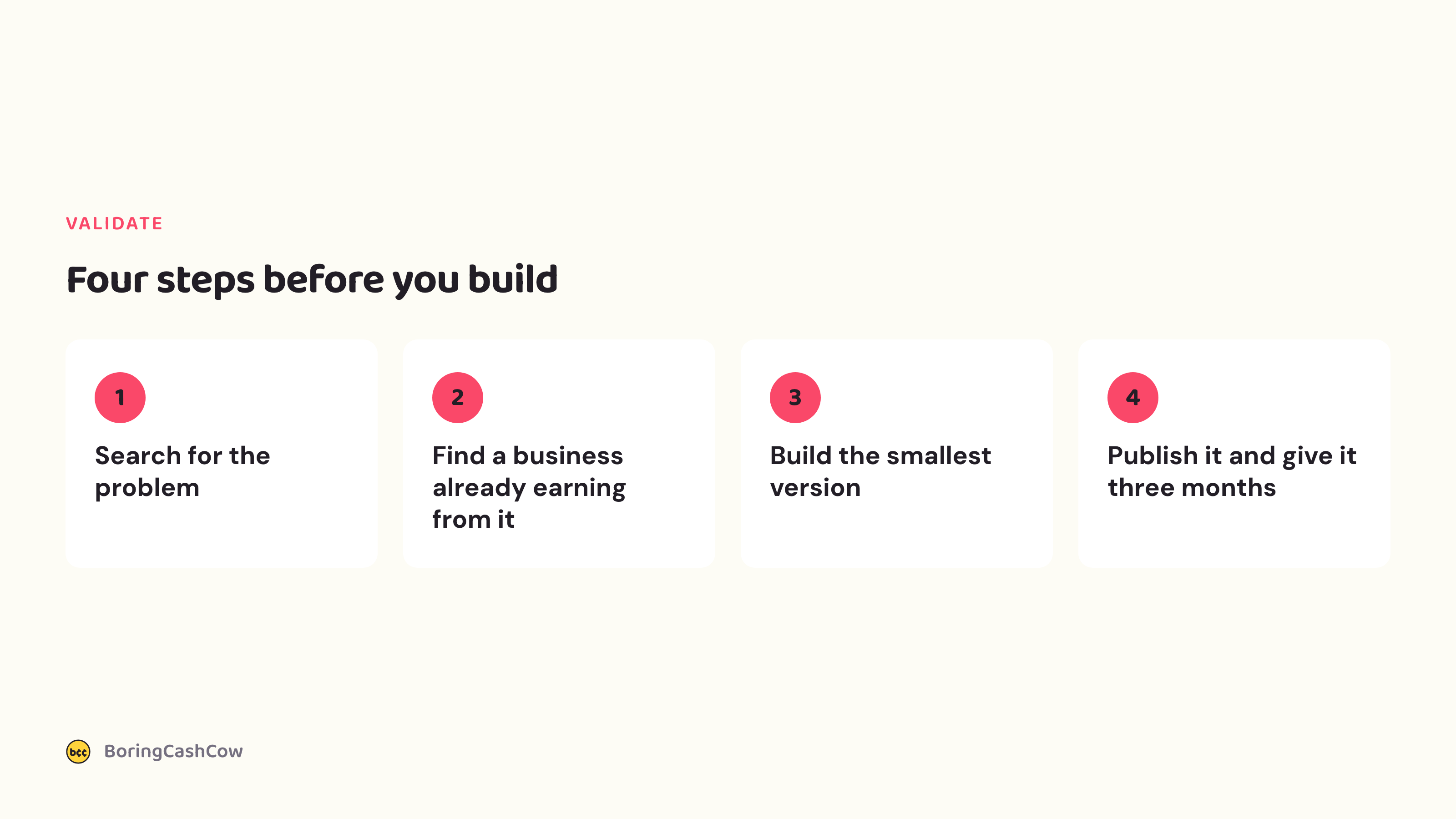
Validation means finding out whether people already want the thing, before you spend three months making it. Four steps cover most cases.
Step 1: Search for the problem. Type the task into Google the way a customer would: "convert bank statement to Excel", "hard drive prices". If the results are forum threads and old tools, there is room. If nothing shows up at all, there may be no demand.
Step 2: Find a business already earning from it. A competitor with revenue is proof, not a problem. Our guide to finding ideas on Reddit shows where founders post their numbers.
Step 3: Build the smallest version. One page, one feature, one template. DiskPrices is a single page. If the small version is useless, a bigger one would have been too.
Step 4: Publish it and give it three months. Put it where people search and wait. Search traffic is slow: in our experience with SEO for boring businesses, it normally takes three to six months to see obvious results. A handful of unprompted visitors who come back is the signal to keep going.
Online business ideas: your questions answered
What businesses can I do online? Three kinds, going by what our case studies cover. Software: a small SaaS, a mobile app or a browser extension. Content and media: a free tool site, a reference site, a newsletter or a job board. Digital products: templates sold on a marketplace. Each of the 12 types above has a real business behind it with reported revenue.
How can I make $10,000 a month from home? Nobody can promise that figure. What we can say is what named businesses report: Bank Statement Converter makes $9,000/month from one conversion tool, and Parseur and Hevy each make $40,000/month. These are established businesses, not first-year numbers, and results are not guaranteed.
What business will boom in 2026? We don't predict booms. The businesses on this list earn because the demand doesn't move much: people needed tractor specifications in 2000 and still do. A business built on steady demand has no boom to catch and no bust to survive.
Which items sell fast? Online, cheap digital files sell fastest because there is nothing to ship. SimplyOrganizedPro has made over 39,000 sales of spreadsheet templates priced at $1–$2.50 since December 2022. Low prices mean you need volume, and the marketplace supplies it.
Do I need money to start an online business? Very little. The most common stack among our case studies, PHP and MySQL on shared hosting, costs under $10/month to run. What you spend is time.
Browse all 100+ boring business case studies →
New boring business breakdowns every week — real revenue, real founders, no fluff. Join the newsletter →