8 One Person Business Ideas — Each Run by a Single Founder
The one person business ideas worth copying are the ones a single founder already runs. Below are eight types of online business, and each is tied to a real company with one person behind it: who that is, what they sell, and the revenue they report. Every one is a boring business — a dull product with steady demand.
We've profiled over 100 businesses on BoringCashCow. This list takes only the ones where our write-up names one founder and no team, so it is shorter than our full list of boring businesses that make money. One name on each, and no funding round.
The eight at a glance
| Business type | Real example | Reported revenue | How it earns |
|---|---|---|---|
| 1. Paid web app | Pinboard | $212K/year | Annual fee |
| 2. Subscription mobile app | Habitify | $1.2M/year | Subscriptions |
| 3. Niche search tool | Seats.aero | $1.5M/year | Recurring revenue |
| 4. AI generator | Emojis.sh | $105K/month | Subscriptions |
| 5. Niche reference site | TractorData | $46,000/month | Display ads |
| 6. Single-page affiliate site | DiskPrices | $5,000/month | Affiliate commissions |
| 7. Freemium tool site | ResumeMaker.Online | $3,500/month | Freemium |
| 8. Template shop | SimplyOrganizedPro | $160K/year | One-time sales |
The figures come from our case studies, linked under each entry. They are what these founders report after years of work, not what a new business should expect in its first year.
Software products
Software suits one person because you build it once and sell it many times. The four below each do a single job.
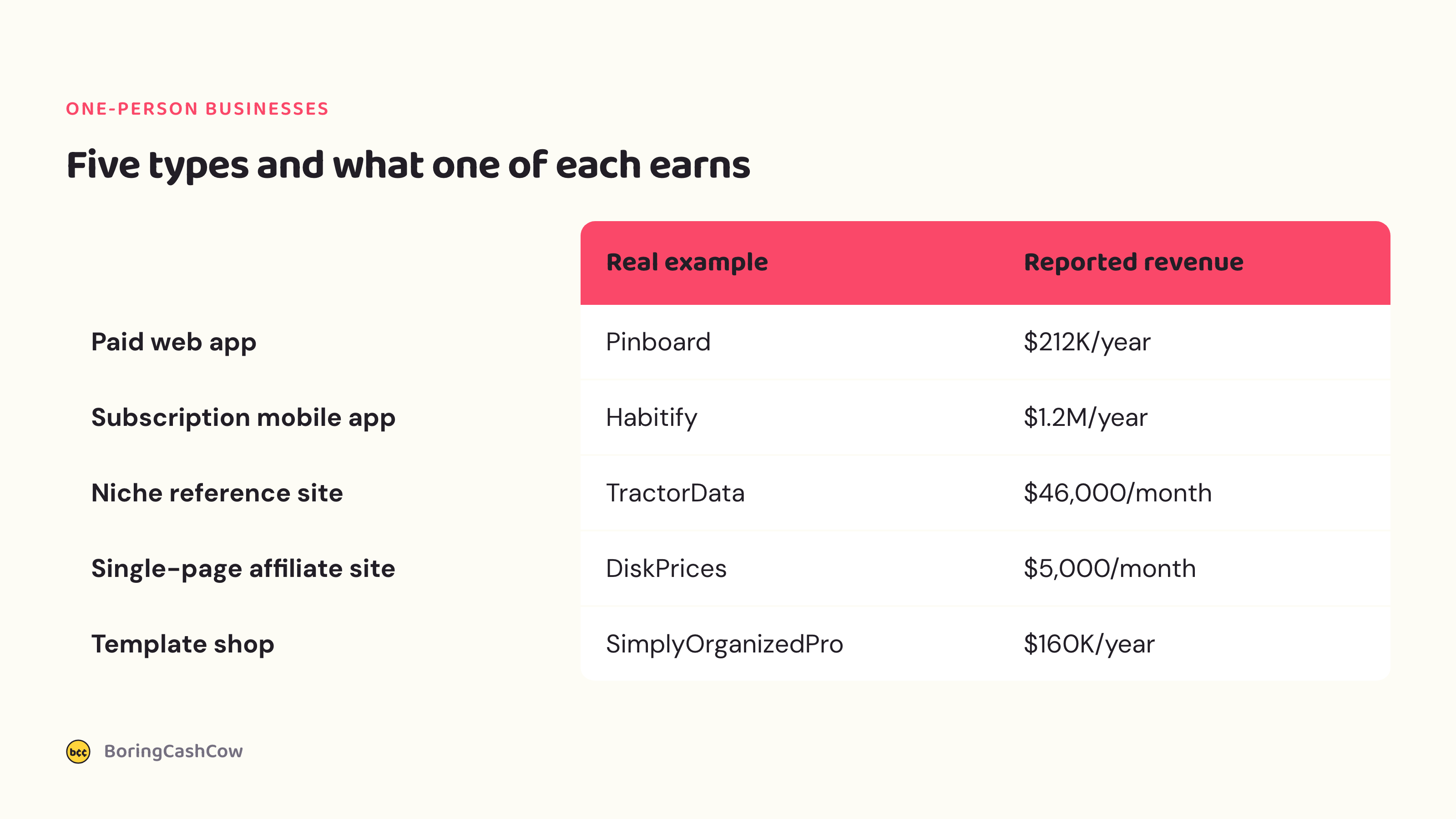
1. Paid web app: Pinboard — $212K/year
Maciej Ceglowski has run this bookmarking service solo since 2009. Users pay $22/year. There is no free tier and no trial, so everyone who signs up is a customer. The stack is PHP, MySQL and vanilla JavaScript. Full case study →
2. Subscription mobile app: Habitify — $1.2M/year
Peter Vu, a self-taught iOS developer from Vietnam, launched a habit tracker in 2017. It reached roughly $100K/month after it was featured on the App Store and he switched to subscriptions. It has 890K+ installs, and he runs it solo. Full case study →
3. Niche search tool: Seats.aero — $1.5M/year
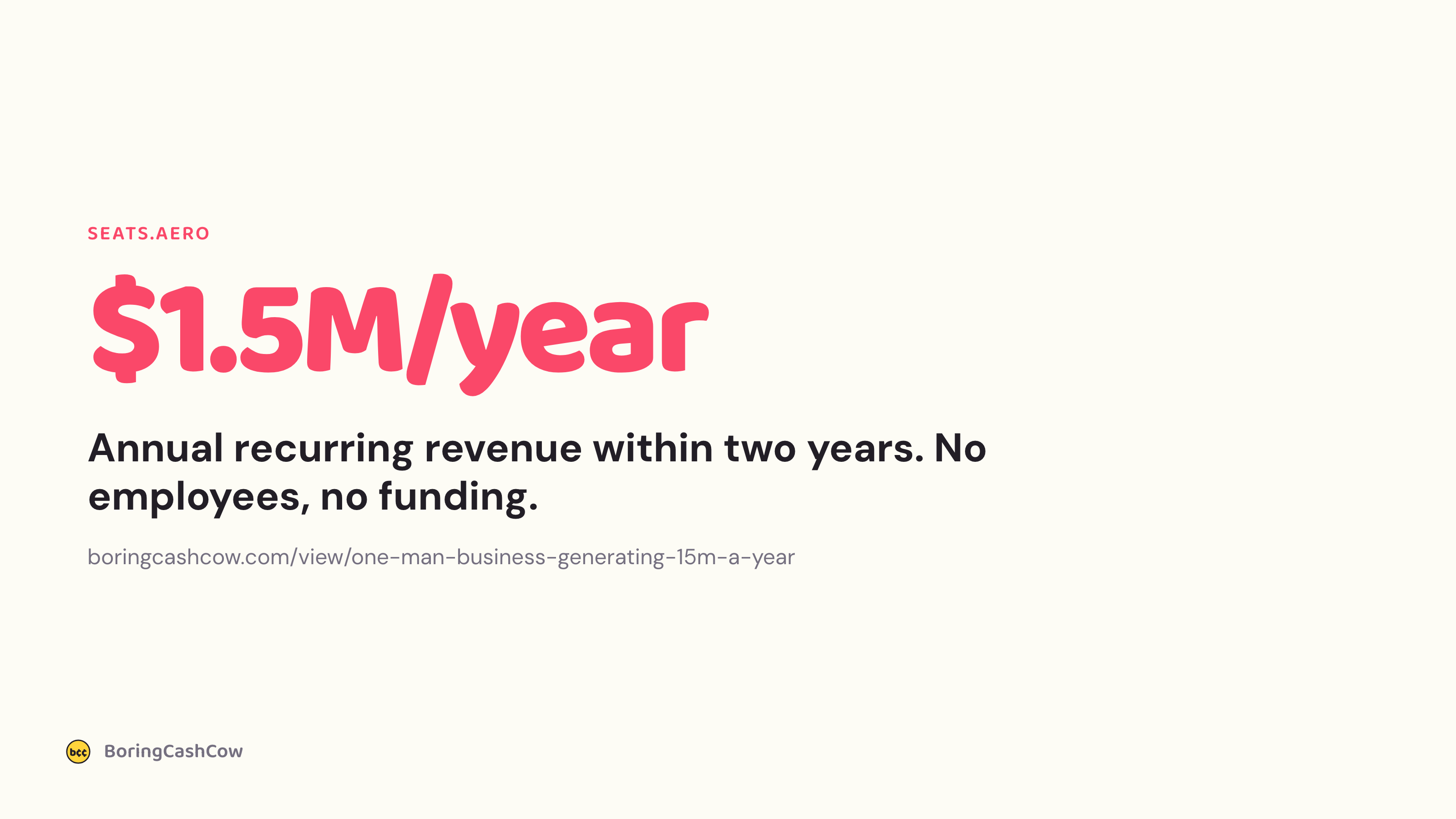
Ian Carroll built a search tool for award flights in mid-2022, so travelers can see where their airline miles will get them a seat. No employees, no funding, and $1.5M in annual recurring revenue within two years. 88.6% of the traffic is direct: people come back because the tool works. Full case study →
4. AI generator: Emojis.sh — $105K/month
Alexandru Ţurcanu, a solo founder, built a site that generates custom emojis with AI and sells subscriptions to it. It gets 703K monthly visits and made $105K in a single month. Full case study →
Three more are in our older post on single-person software businesses that make millions.
Content sites
A site that organizes facts people look up, paid for by ads or affiliate links. There is less code here and more waiting.
5. Niche reference site: TractorData — $46,000/month
Peter Easterlund launched a website of tractor specifications in 2000. It gets 1.2 million monthly visits and earns $46K/month from display ads. PHP, MySQL, one person. All of the revenue is ads, so there are no customers to bill. Full case study →
6. Single-page affiliate site: DiskPrices — $5,000/month
Jeremy Grosser built one web page that lists hard drive prices. It earns $5K/month in Amazon affiliate commissions on 80,000 monthly visits. One page, one person, Python and SQLite. Amazon takes the orders and ships the drives. Full case study →
Free tool sites
A free tool brings visitors from search, and a paid tier or ads turn some of them into revenue.
7. Freemium tool site: ResumeMaker.Online — $3,500/month
Fernando Pessagno, an Argentinian product designer, launched this resume builder as a side project in 2018 and runs it solo. It is free to use with a paid upgrade, ranks #1 for "resumemaker", and grew entirely through SEO. jQuery and PHP. This is the smallest business on the list, and it is here on purpose: a one-person business doesn't have to reach seven figures to be worth running. Full case study →
Digital products
A file you make once and sell on a marketplace. Nothing to ship, nothing to restock.
8. Template shop: SimplyOrganizedPro — $160K/year
A seller known as HJ started listing spreadsheet templates on Etsy in December 2022. The case study names nobody else behind the shop. Each template sells for $1–$2.50, and the shop has made over 39,000 sales across 24 products. Etsy brings the buyers and takes the payment, so there is no website to build or rank. Full case study →
What about newsletters and services?
Both appear on most lists of businesses one person can run. Neither has a numbered entry here, because we don't have a case study of one with a single founder and no team, and we don't list an idea without an example.
The closest newsletter is TLDR, which Dan Ni started in 2018 and which now makes $5M/year from sponsorships. The case study says the team is now four full-time employees, so it stays off the list. A daily email is also a daily job, which matters when there is no one to cover for you.
A service is the fastest way for one person to earn, because you can sell your time this week. The catch is that it stops earning when you stop working. If you go that way, fix the scope and the price so you aren't writing a custom quote for every client. Our guide on how to productize your services covers that.
What you handle alone
Everything. Building, support, marketing, billing, and the server at 2 a.m. The eight founders above don't work harder than a team would. They chose businesses where most of that list never comes up.
No sales. None of these businesses needs a sales call. Pinboard charges $22/year with no trial. TractorData and DiskPrices are paid by ad and affiliate networks. SimplyOrganizedPro sells through Etsy's checkout.
No paid marketing. Traffic arrives through search or habit: ResumeMaker.Online grew entirely through SEO, and 88.6% of Seats.aero's traffic is direct. That takes time to build, and it costs nothing to keep.
No complicated stack. PHP, MySQL, jQuery, Python, SQLite. Simple tech is cheap to run and easy to maintain alone.
No second product. One bookmarking service, one page of prices, one habit tracker. One person can run a business when the product is small enough to hold in one head.
What you can't remove is the risk of being the only one. If you are ill or away, the business waits for you. A reference page can go weeks without attention and still earn. A product with paying subscribers can't.
How to start a one person business
Start from a task you already understand. A product designer built the resume builder. An iOS developer built the habit tracker. Knowing the problem is the one advantage a single founder has over a funded team.
Check that people already look for it. Type the task into Google the way a customer would. Old tools and forum threads in the results mean there is room. Our list of online business ideas ends with four steps for validating an idea before you build it.
Build the smallest version. DiskPrices is a single page. If one page is useless, ten would have been too.
Keep your job while it grows. DiskPrices, ResumeMaker.Online and TractorData all began as side projects. Search traffic is slow, and it normally takes three to six months to see obvious results.
Frequently asked questions
What are successful small businesses? Going by our case studies, the ones that last solve an everyday problem with steady demand. TractorData has earned from tractor specifications since 2000, and Pinboard has charged for bookmarks since 2009. Neither depends on a trend.
Is $5000 enough to start a business? For a business like the ones above, yes, and most of it would go unspent. DiskPrices, ResumeMaker.Online and TractorData were built as side projects with zero startup capital, and the most common stack among our case studies costs under $10/month to host. What you spend is time, and results are not guaranteed.
What business will boom in 2026? We don't predict booms. A one-person business does better on demand that doesn't move, because one person can't chase a trend and maintain a product at once. People needed tractor specifications in 2000 and still do.
What business can two people start? The same types, with one more pair of hands. Guillem Ros and Desmond McNamee built Hevy, a workout tracker that makes $40,000/month. Sylvestre Dupont and Sylvain Josserand built Parseur, a document parsing tool that makes $40,000/month.
How much can a one-person business make? On this list, from $3,500/month for ResumeMaker.Online to $1.5M/year for Seats.aero. Nobody can promise you either figure. These are established businesses, and two of them are more than fifteen years old.
Browse all 100+ boring business case studies →
New boring business breakdowns every week — real revenue, real founders, no fluff. Join the newsletter →